Article · · By Innam Dustgir
AI Decision Making in Business: Who Decides
A business can buy an AI system that works and still get almost nothing from it. The tool gives a good answer. A capable employee looks at it, hesitates, and does it their own way.
It is easy to read this as resistance to change. Usually it is something more rational. AI decision making in business fails less often because of the technology and more often because nobody moved the authority, or the accountability, along with the tool.
If the person is still blamed when things go wrong, they will keep the final say. I would too.
Why good employees override AI
Picture someone on your team who approves discounts on large orders. You give them a system that recommends the discount, and in testing it is faster and makes fewer mistakes than the old way.
Now look at it from their side. If they follow the system and the order loses money, the question in the meeting will be "why did you approve this?" If they override it and a good client walks away, nobody notices. Overriding is the safe choice for them, even when the tool is right more often.
So the AI stays an adviser. You pay for automation and get a second opinion that people mostly ignore. Nobody did anything wrong. The structure simply rewards the old behaviour.
Authority and accountability have to move together
Every decision in a company has two parts: who is allowed to make it, and who answers for the result. When AI enters the process, founders often change the first and forget the second.
The rule I find useful is simple. Whoever holds the authority holds the accountability.
If the system is allowed to decide, someone has to own the system: its rules, its limits and its results. If a person keeps the final call, they need the time and the information to make it properly, not a rubber stamp at the end of a queue.
What does not work is the middle ground, where the machine decides in practice but a person is still blamed in theory. That arrangement produces either constant overrides or quiet, nervous approvals. Both waste the investment.
Sort decisions before you automate them
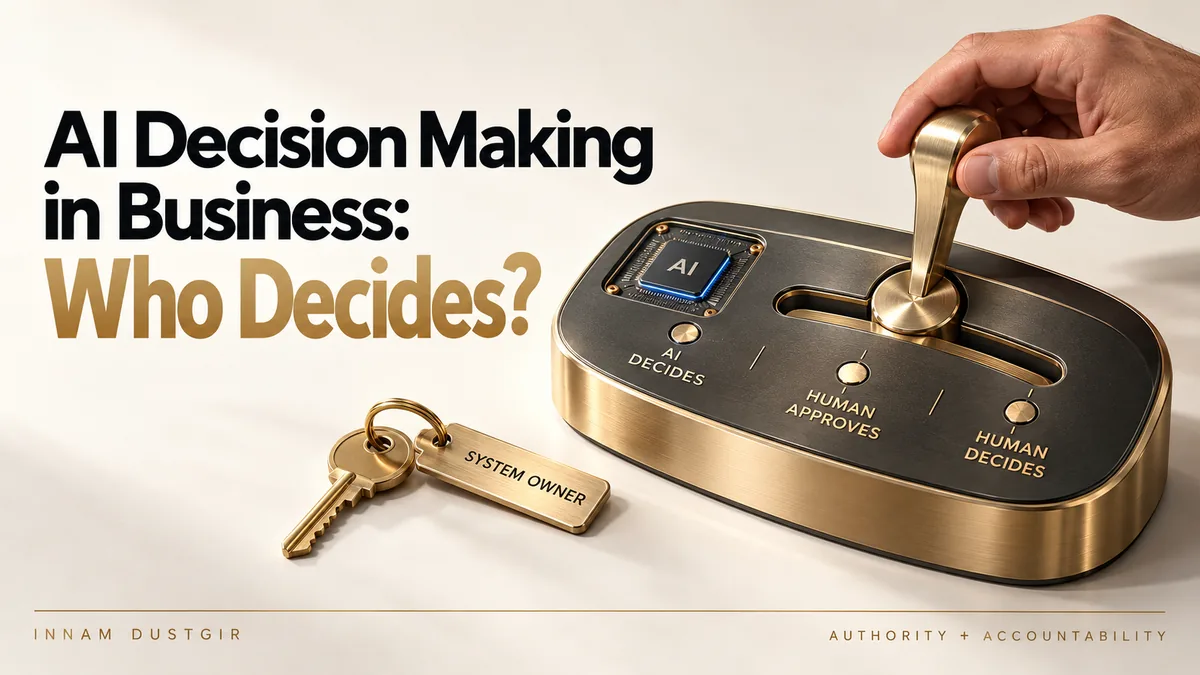
Not every decision should be handed over in the same way. Before giving AI a role, I would put each decision into one of three groups.
- Routine and easy to reverse. Scheduling, categorising, standard replies, simple reorders. Let the system decide, and check samples on a regular basis.
- Important but frequent. Pricing exceptions, credit terms, shortlisting candidates. The system recommends, a named person approves, and both the recommendation and the final choice are recorded.
- High stakes or unclear. Strategy, key hires, large commitments, anything hard to undo. People decide, and AI helps with analysis and options.
This is what a human in the loop should mean in practice: a person placed deliberately where judgment matters, not added everywhere out of caution. It also connects to how to delegate effectively, because handing a decision to a system needs the same clarity as handing it to a person.
Who is responsible when AI makes a mistake
The business is. Customers, regulators and partners will not accept "the software decided" as an answer, and they should not.
Inside the company, though, responsibility needs a name. For every AI system that decides or recommends, one person should own its outcomes. That person sets the limits, watches the results, and has the authority to change or switch it off.
The person who followed a sound recommendation in good faith should not carry the blame when it turns out wrong. If they do, everyone else learns to override, and you are back at the start.
AI decision making in business: a practical setup
A few practical steps make the difference between a tool people use and a tool people work around.
- Write down the decision rights. For each use, state what the system decides, what a person approves and what stays fully human. One page is enough.
- Name an owner for each system. One person, not a committee.
- Make overriding normal but visible. People should be free to override, with a one-line reason. Review those reasons every month. They show you where the system is weak or where trust is missing.
- Change what you reward. If people are judged only on what went wrong, they will protect themselves. Judge them on the quality of the decision process, including when they followed the system.
- Check the numbers that matter. Compare outcomes with and without the system, using the same business measures you would use to measure AI ROI.
None of this slows the business down. Clear decision rights usually speed it up, the same way making decisions faster as a founder depends on knowing which calls are yours and which are not.
The real work is organisational
This idea comes from a recent Harvard Business Review article on why even your best employees override AI systems that work, which argues that companies are adopting AI faster than they are redesigning roles and accountability around it.
For a founder, the lesson is practical. Buying the tool is the easy part. The hard part is deciding who decides, who answers for the result, and making sure those two things never drift apart.
Frequently asked questions
How is AI used in business decision making?
Many businesses use AI to recommend rather than decide, for example on pricing, credit terms or shortlisting. The best results come when each use has clear decision rights: what the system decides, what a person approves and what stays fully human.
Who is responsible when AI makes a mistake?
The business is responsible to customers and partners. Inside the company, one named person should own each AI system's outcomes, with the authority to change its limits or switch it off.
Why do employees ignore or override AI recommendations?
Usually because they are still personally blamed if the outcome is bad. When authority moves to the system but accountability stays with the person, overriding becomes the safe choice.
Will AI replace human decision making in business?
For routine, reversible decisions it often can. For high-stakes or unclear decisions, people should still decide, with AI helping on analysis and options.
Originally published on LinkedIn