Article · · By Innam Dustgir
Authentic Leadership Without Oversharing
Many founders now believe the way to look real in front of a team is to talk about the hard parts. The failed launch, the bad year, the night they nearly gave up. It feels honest, and sometimes it is.
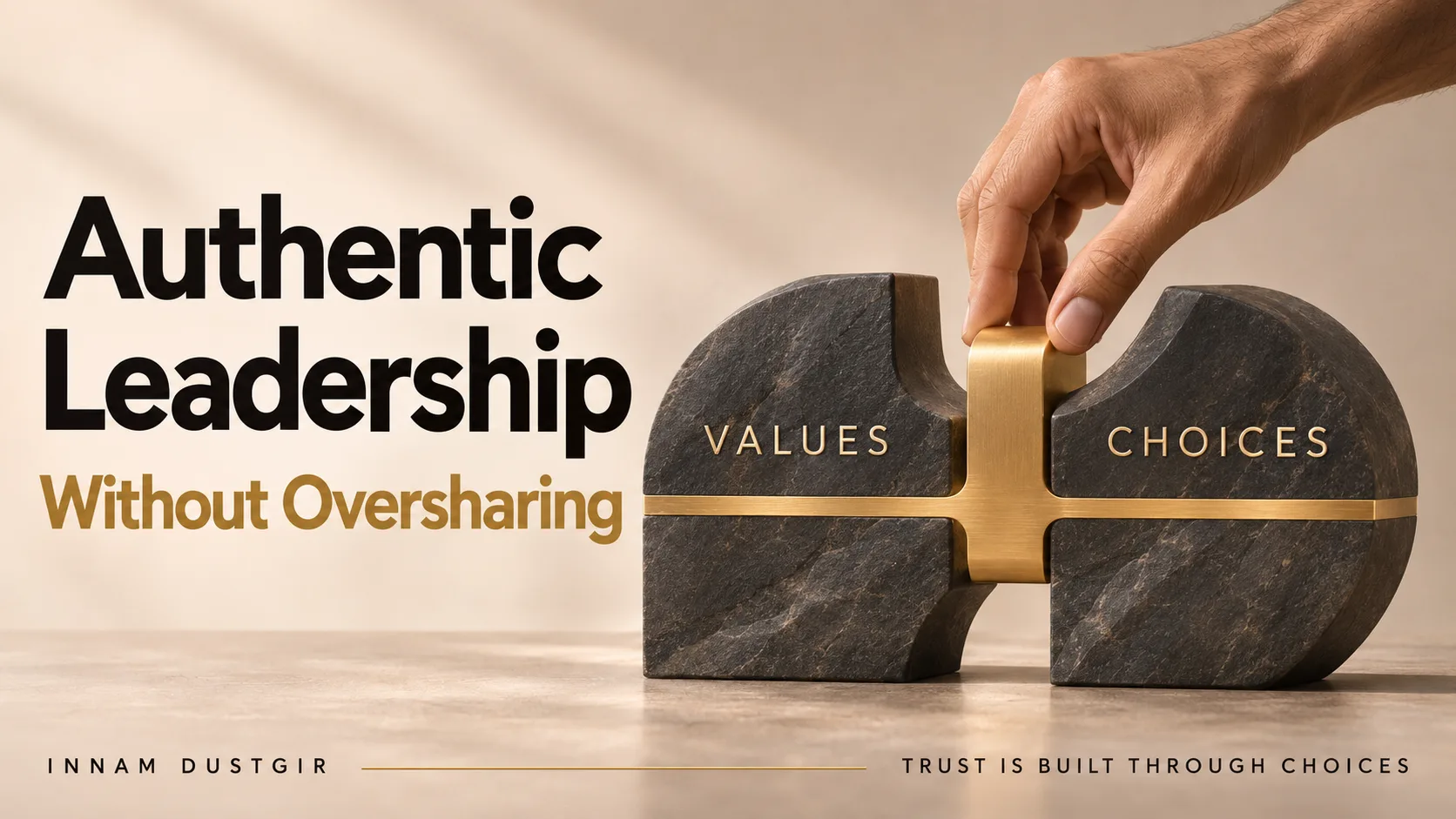
But authentic leadership is not the same as sharing your struggles. People can feel sorry for you and still not trust your judgment. What makes a leader believable is something else: seeing that your choices match what you say you value, especially when those choices cost you something.
This matters a lot for founders. In a young company, the team watches the founder closely and copies what it sees.
Why sharing setbacks is not the same as being authentic
A setback is something that happened to you. A choice is something you did.
When a leader tells the team about a hard time, people usually respond with sympathy. That is human and kind. But it does not tell them much about how you will act the next time things get difficult.
There is also a quieter risk. If every honest moment is a story of pain, vulnerability starts to become a performance. Teams notice when hardship is shared to win support for a decision, and it lands badly.
None of this means you should hide problems. When the business is in trouble, people deserve to know. That is information, and it belongs in any serious effort at keeping a team motivated during difficult times. It is just not, by itself, proof of character.
What authentic leadership looks like in practice
The signal people trust is a voluntary choice that went against the easy path and cost the leader personally.
Picture a founder who turns down a large contract because it would pull the team away from the customers the company was built for, and then tells the team plainly why.
Or picture a founder who takes a smaller salary for a year so an important hire can be made, and says so simply when someone asks how the business could afford it.
What makes these moments land is not the drama. It is that people can see the value behind the decision, and they can see the price. Values that never cost anything are just preferences.
So when I think about how to be an authentic leader, I spend less time on what to reveal and more on what my decisions show.
Is vulnerability a weakness in leadership?
No. But it is not the whole of authenticity either.
Saying "I don't know," "I got that wrong" or "I need help with this" is valuable. It makes it safer for others to say the same, and it keeps bad news moving up instead of being buried.
The useful test is relevance. Before sharing something personal, ask whether it helps the team understand a decision, a value or a next step. If it does, share it simply.
If it is mainly about how you feel, a trusted peer or mentor may be the better listener, which is one more reason to be clear about whose advice deserves your attention.
Vulnerability in leadership works best as a habit of honesty about the work, not as a confession about yourself.
Earn trust before you break convention
One thing is easy to miss. A leader who has built credibility over time gets more room to make unusual choices. A new manager, or a founder in the first months with a new team, usually gets less.
That is not unfair. People need a track record to judge a surprising decision against. If they have watched you keep your word on small things, an unusual call reads as conviction. If they have not, the same call can read as impulse.
For founders, the groundwork is ordinary. Do what you said you would do. Treat people consistently. Explain your reasoning before you need anyone to accept something hard. This is also what makes real buy-in from your team possible when the strategy changes.
A simple way to practise authentic leadership
Here is the short version I would give any founder.
- Lead with the choice, not the struggle. When you share something personal, connect it to a decision you made and the value behind it.
- Name the cost honestly. Do not inflate it. If the choice was easy, do not present it as a sacrifice.
- Check relevance before you share. Ask whether it helps the team understand the work. If not, keep it for a trusted peer.
- Admit mistakes quickly and plainly. Say what went wrong and what you are changing. Skip the long story.
- Build credibility in small things. Consistency is what gives your bigger, unusual choices meaning.
- Never use a personal story to win an argument. If it is there to make disagreement feel unkind, it is manipulation, even if every word is true.
Authenticity is shown, not announced
This idea comes from a recent Harvard Business Review research piece, When Being Authentic Undermines Your Leadership, which found that people see leaders as more authentic when they disclose a choice that cost them something than when they share a setback.
For a founder, the lesson is practical. Your team does not need you to be perfect, and it does not need every hard story. It needs to see that what you say you value shows up in what you choose, especially when choosing it is expensive.
Frequently asked questions
What is authentic leadership?
Authentic leadership means your decisions and behaviour match the values you say you hold. It is less about how much you share and more about whether people can see those values in your choices, especially the costly ones.
How can I be an authentic leader without oversharing?
Share what helps the team understand a decision, a value or a next step, and keep the rest for trusted peers. Be quick and plain about mistakes, and connect personal stories to choices you made.
Is vulnerability a weakness in leadership?
No. Admitting uncertainty or mistakes builds trust and makes it safer for others to be honest. It works best when it is relevant to the work rather than a story about yourself.
What are examples of authentic leadership in business?
Turning down profitable work that conflicts with the company's priorities and explaining why, accepting a personal cost to make an important hire, or admitting a wrong call quickly and changing course. In each case the value is visible in a choice.
Originally published on LinkedIn