Article · · By Innam Dustgir
Competitive Advantage in the Age of AI
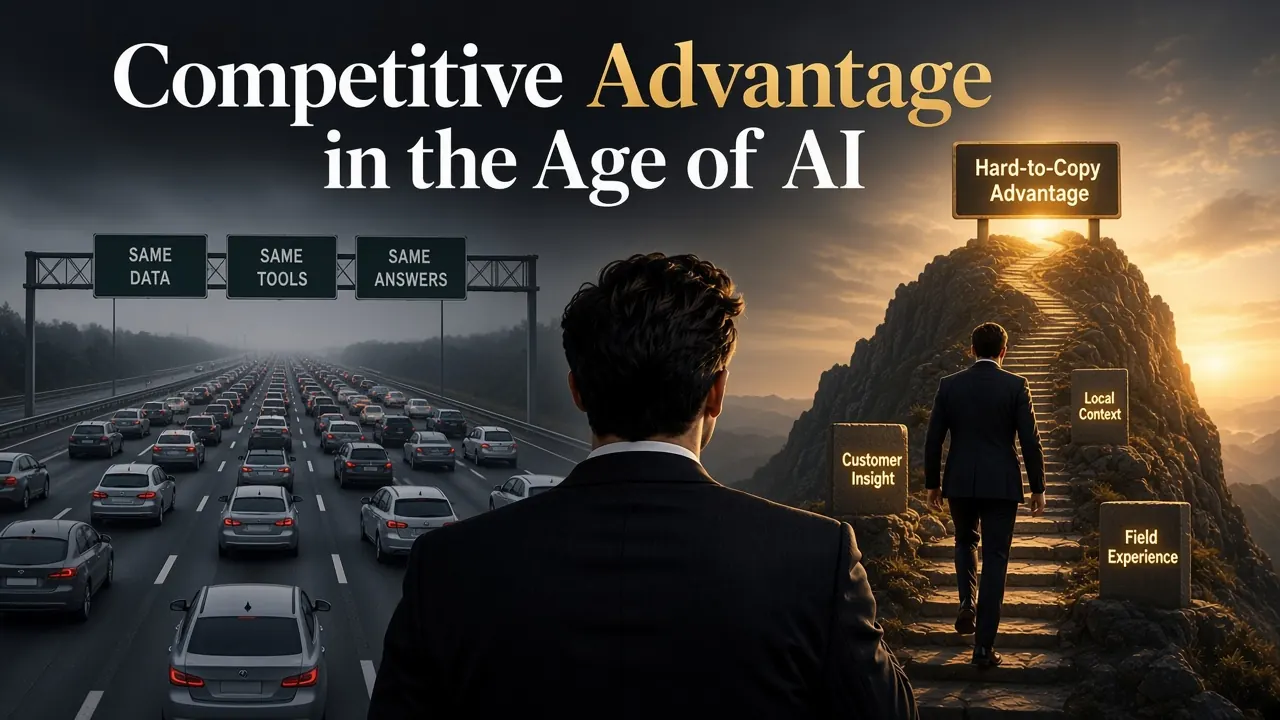
Most founders now have access to the same strategic help. Ask an AI tool to size a market, map competitors or stress-test a plan, and you get a sharp answer in minutes. That is genuinely useful. It is also the problem.
When everyone asks similar questions of similar tools trained on similar data, they reach similar conclusions. The analysis gets better, and the strategies start to look the same.
Same Tools, Same Answers
Good analysis used to be a real edge. The company that understood its market more clearly, and sooner, could move before others noticed the opening. That gap is closing. A small team today can produce a market study that once needed a consulting firm.
So if your strategy is built mostly on what public data and standard frameworks can tell you, assume your competitors have it too. The opportunity you spotted on Monday is probably on someone else's slide by Friday. Being right is no longer enough. You need to be right about something others cannot easily see.
Advantage Lives in Context
The insights that hold their value are the ones that are hard to write down. Why a certain type of customer hesitates at the last step. Which supplier delivers when it matters and which only looks good on paper. How decisions really get made inside the companies you sell to. What a regulator cares about beyond the written rules.
This kind of knowledge sits in people, relationships and experience. It is tied to a specific market and a specific moment, so it does not transfer cleanly into a report or a prompt. That is exactly why it lasts. A competitor can copy your pricing page in an afternoon. They cannot copy years of understanding how your customers think.
For founders building from markets like Pakistan, this matters more than it seems. Global tools learn mostly from other markets. Local context, such as how trust is built, how buying decisions move and the gap between what customers say and what they do, is often where the real insight is.
Stay Close to the Work
You do not collect this knowledge by reading more. You build it by staying near the work. Sit in on sales calls. Read support tickets yourself. Visit customers instead of only surveying them. Pay attention when something surprises you, because surprises are where your assumptions break.
It also matters that this knowledge does not sit only with the founder. Teams that share what they learn from the field, in short notes or regular conversations, turn individual instinct into something the company can act on. The goal is not to document everything, which is impossible, but to keep the people closest to customers involved in strategy.
Use AI for Speed, Not Direction
None of this means ignoring AI. The right role for it is to test assumptions, cover the basics faster and challenge your thinking. It handles the common ground well, and that frees up time for the work only your team can do.
The mistake is letting it set direction. If a strategy could have been produced by anyone with the same tool, it is not much of a strategy. Use the analysis as a floor, then ask what you know that the data does not.
This piece was prompted by a Harvard Business Review article by Giovanni Gavetti, Hart Posen, James Siderius and Zia Zaman, who argue that as AI evens out analysis, distinctive strategy depends on "sticky knowledge" that is hard to articulate or transfer. In my view, the most valuable thing a founder can own right now is understanding that cannot be downloaded.
Originally published on LinkedIn