Article · · By Innam Dustgir
Vibe Coding for Business: From Demo to Tool
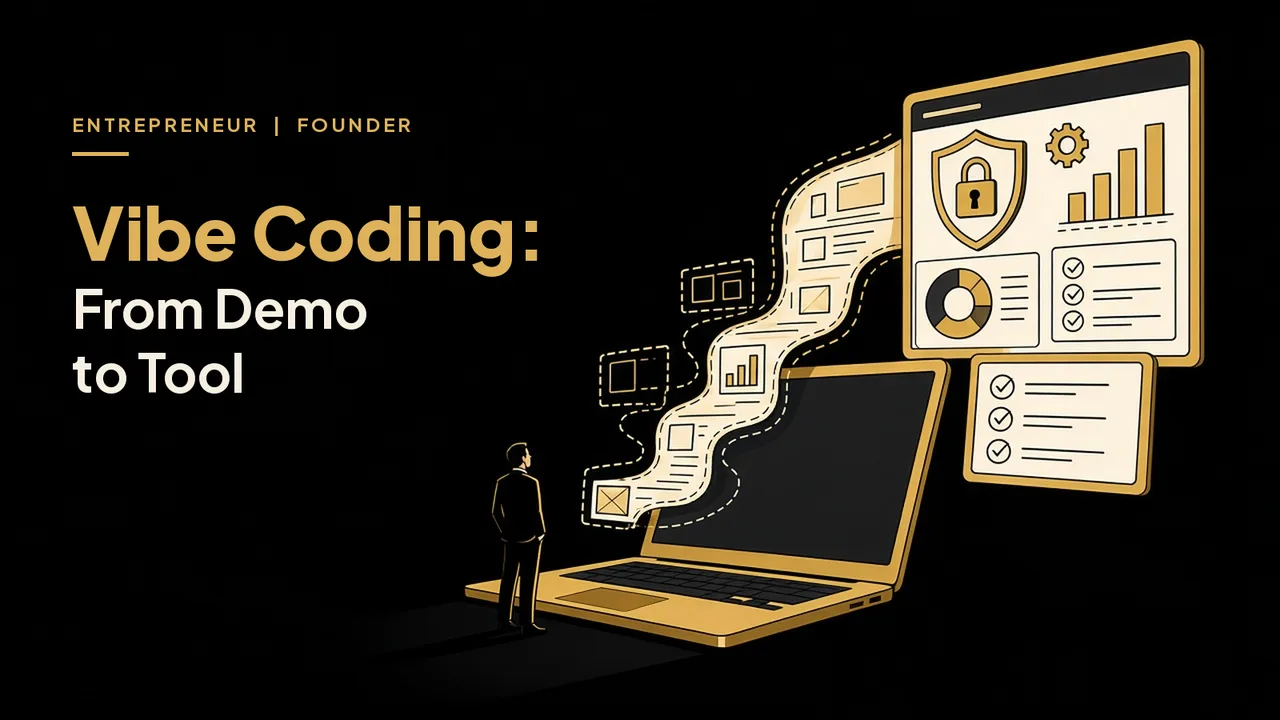
A working app in an afternoon is no longer a story. Anyone on your team can describe a tool in plain language, let AI write the code and show you something that runs before the day ends. The demo looks finished. Everyone in the room is impressed.
That is exactly the moment I slow down. Vibe coding for business is one of the most useful shifts I have seen for founders, but a demo that works once is not the same as a tool your team can rely on every day. The space between those two things is where the real cost sits, and most people only see it after they have already said yes.
Why vibe coding for business feels almost free
The cost of building the first version has collapsed. A sales lead tracker, a quote calculator, a small dashboard for weekly numbers: things that once needed a developer and a few weeks can now be put together by a manager who has never written code.
For a founder, that is a real advantage. You can test an idea before you spend on it. You can see whether a workflow makes sense by using it, not by debating it in a meeting. I would much rather my team try something small and learn than wait months for a perfect specification.
But building was never the expensive part. The expensive part is everything that comes after: keeping the tool running, keeping data safe, fixing it when something upstream changes, and knowing who is responsible when it breaks at the wrong time. AI made the first step cheap. It did not make the rest cheap.
A prototype is not a tool yet
A prototype answers one question: could this work? A tool answers harder ones. Does it work for every user, every day, with real data? What happens when the person who built it goes on leave? What happens when the spreadsheet it reads from gets renamed?
This is the deployment gap, and it is where most vibe-coded projects quietly fail. Not with a dramatic crash, but with slow decay. Numbers stop matching. A few people stop trusting it and go back to their old way. Six months later you have one more system to maintain and fewer people using it.
Before anything moves from demo to daily use, I want three answers in writing. Who owns this tool? What data does it touch? What do we do if it stops working tomorrow? If nobody can answer those, it is still a prototype, no matter how polished it looks.
It also helps to fix the process before you build software around it. If the workflow is messy, AI will simply help you produce a messy tool faster. I have written before about why business process automation should start by fixing the process first, and the same rule applies here.
Bring a technical person in early, even if they do not build
The common mistake is to call the engineer only when the tool is already in use and something has gone wrong. By then the decisions that matter have been made: where the data lives, how people log in, what the tool is allowed to change.
A better habit is to involve someone technical from the first week, not to write the code, but to ask the boring questions early. Where is this hosted? Who can see the data? Is anything sensitive being pasted into prompts? What breaks if this tool goes down? An hour of that conversation at the start is cheaper than a week of cleanup later.
For a non-technical founder, this is the most practical safeguard available. You do not need to read every line of code. You need someone you trust to look at the shape of what was built before your team depends on it.
Keep connections small to reduce vibe coding risks
Most vibe coding risks grow with every system a tool is connected to. A tool that reads one sheet and shows a chart is low risk. A tool that can write to your accounting system, send emails to customers and pull from your client records is a different thing entirely, even if it was built in the same afternoon.
So I keep connections deliberately small. Give the tool access only to the data it truly needs. Let it read before it is allowed to write. Keep customer data, payments and anything financial out of early versions. If the tool proves its value, you can open more doors later, carefully and on purpose.
This is not about fear of AI. It is the same principle you would apply to a new hire: you do not hand over every key on day one.
Resist the urge to scale what works
When a vibe-coded tool works well for one team, the natural reaction is to roll it out everywhere. More users, more departments, more use cases. That is usually where things start to break.
Every new user brings new edge cases. Every new use case adds requirements the original builder never planned for. A tool designed for five people in one team rarely survives being stretched across fifty people with different needs. It is the same pattern I see when companies grow faster than their foundations, and I covered it in detail in the risks of scaling too fast.
The better move is to let a tool stay small and useful for a while. If demand keeps growing, treat that as a signal to rebuild it properly, with the right people and the right standards, instead of stretching the prototype further.
How I think about vibe coding as a founder
AI has changed what a small team can do, and I think founders who ignore that will fall behind. I have argued that AI is changing the rules of entrepreneurship, and building your own tools is part of that change.
But speed at the start does not remove responsibility at the end. My view is simple. Use vibe coding for business freely to explore, test and learn. Be strict about what is allowed to become a daily tool. Name an owner, involve technical judgment early, limit what the tool can touch, and do not scale it just because the first demo was impressive.
This piece was sparked by a recent Harvard Business Review article on turning vibe-coded prototypes into tools companies can actually use, which describes this deployment gap well. The lesson for founders is the same one that applies to most of business building: the first version is the easy part. Making it last is the work.
Frequently asked questions
Is vibe coding safe for business use?
It can be, for low-risk internal tools and prototypes. It becomes risky when a tool handles customer data, payments or connects deeply to core systems without someone technical checking how it was built.
Can a non-technical founder use vibe coding?
Yes. Non-technical founders can use it to test ideas and build simple internal tools. The key is to involve a technical person early to check hosting, data access and what happens if the tool fails.
What are the main vibe coding risks for a small business?
The biggest risks are tools nobody owns, sensitive data exposed through loose access settings, and prototypes stretched to more users than they were built for. Most of these come from skipping decisions, not from the AI itself.
When should a vibe-coded prototype be rebuilt properly?
When it becomes something your team depends on every day, starts touching sensitive data or needs to serve many more users. At that point, treat the prototype as a specification and rebuild it with proper standards.
Originally published on LinkedIn